

Optical cable technology is now commonly used in dark fiber networks. It replaces copper cables in systems that need more control and their own network space. As data use continues to grow, dark fiber lets organizations own or rent unused fiber lines. This makes it easier to build networks that can be turned on and expanded when needed.
This wider use shows why dark fiber is seen as a long-term network choice, not just a basic connection. With faster speeds, fewer signal problems, and easy expansion, optical cable technology supports new systems and future growth. You can understand these benefits more easily by looking at how real networks use dark fiber.
What is an optical cable used for?
An optical cable is the main line used in dark fiber networks. In general, it lets companies use their own fiber lines without using the provider’s equipment. At the same time, in telecom networks, dark fiber helps send data over long distances. Because of this, companies can turn the network on when needed and also add more capacity as traffic grows.
In many cases, in data centers and business networks, dark fiber connects buildings and systems with direct and fast links. As a result, this helps companies control their network speed, data use, and security. In addition, it supports cloud access, data backup, and data sharing without relying on crowded shared networks.
For this reason, for internet service providers and large companies, optical cable is the base of dark fiber backbone networks. Overall, these networks provide fast and flexible connections. Not only do they support more online services, but they also connect different areas and prepare for future needs, which makes dark fiber a good choice for stable performance and long-term growth.
Key advantages of optical cable
As digital work grows, networks must be fast and stable. Optical cable is a common choice because it fixes many issues in older networks. It helps businesses run daily tasks and handle more data as they grow.
Speed is not the only need. Businesses also want networks that work well, stay safe, and are easy to expand. Optical cable gives steady connections, better safety, and simple growth, which is why many companies use it today.
1. Faster data transmission speeds
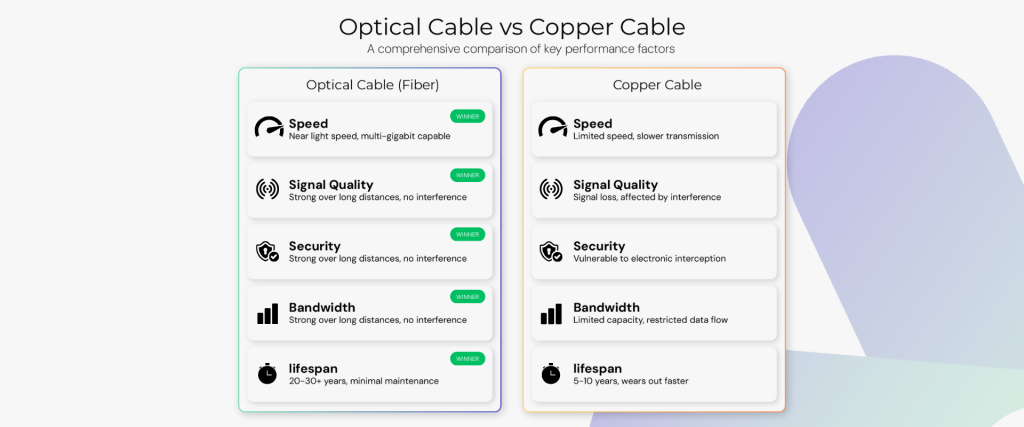
Fiber networks send data very fast, close to the speed of light, and can easily handle gigabit speeds. Copper cables are much slower in comparison. Businesses that use large amounts of data see clear benefits from this performance. Speed is often the main reason companies move to newer fiber networks.
2. Better signal quality and reliability
Optical cable keeps signals strong over long distances and is not easily affected by interference. Copper cables often face signal loss and outside noise. With more stable connections, businesses can rely on steady network performance. This reliability is very important for daily operations and critical systems.
3. Stronger security
Fiber connections are more secure because they do not send out electrical signals that can be tapped. Copper cables are easier to intercept using electronic methods. Data sent through fiber is harder to access without permission. This makes fiber a good choice for organizations that handle sensitive information.
4. Higher bandwidth capacity
A single fiber line can carry much more data than a copper cable of the same size. It can also send multiple signals at the same time. This helps networks handle growth without major changes. Choosing fiber makes it easier to support future needs.
5. Long life and better value over time
Optical cable is durable and can last for many years with little maintenance. Copper cables wear out faster, especially in tough conditions. While the first cost may be higher, fiber reduces repair and replacement costs over time. This makes it a smart long-term investment for many businesses.
Why dark fiber matters for enterprise networks?
Dark fiber is important for enterprise networks because it lets companies control their network, security, and future growth using optical cable infrastructure. With this approach, companies own their bandwidth and therefore do not share the network with others. As a result, this helps keep the network simple, stable, and reliable for daily business use.
For this reason, ARNet is a good choice for companies that need dark fiber services with a wide optical cable network across Southeast Asia. In addition, its complete support helps companies connect faster and at the same time keep the network running well. To learn more, visit ARNet’s website and plan for future needs with its dark fiber services.
About the Author
Nabila Choirunnisa, Digital Marketing Executive at ARNet