

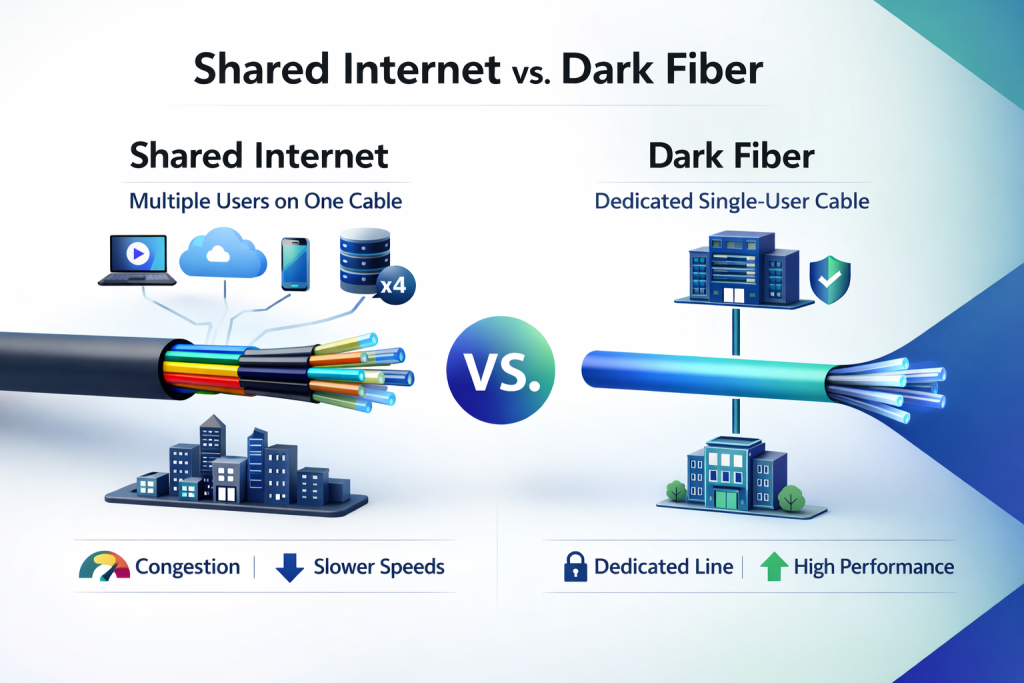
As digital work grows, businesses need an internet that can handle a lot of data without becoming slow. Many companies still use the shared internet. This means many users are on the same connection, so speed becomes slower during busy times. Because of this, more businesses choose dark fiber internet for a stable and safe connection.
With dark fiber internet, your business uses its own fiber cable that is not shared with others. This gives you full control of your network. You can easily manage speed, keep data more secure, and add more capacity as your business grows.
What is the speed of dark fiber internet?
Dark fiber internet speed depends on the equipment you connect to the fiber, not the fiber cable itself. This means businesses can upgrade speed whenever their data needs increase. A September 2025 report shows more companies choose dark fiber because it offers near unlimited capacity and better control over performance.
Real world tests also show how powerful fiber technology is. For example, dark fiber cables can support speeds much faster than normal home internet. In 2024, researchers at Aston University sent 402 terabits per second through a standard fiber cable, showing how much potential existing fiber still has.
Soon after, another record was set. In November 2025, scientists in Japan reached 430 terabits per second using fiber optic technology. Together, these results show that dark fiber internet can handle extremely large amounts of data when paired with the right equipment.
What are the challenges of using dark fiber and how can you solve them?
Dark fiber internet has several challenges, including cost, technical expertise, limited geographic, regulatory complexity, maintenance, and contract commitments. Each one can be managed with the right approach. Below is the detailed explanation of each of them.
1. High upfront costs
Dark fiber can cost around $50,000 per mile for leasing and over $100,000 for equipment. To manage this, start small and only activate what you need first. You can also use equipment financing or share costs with other businesses in the same building.
2. Technical expertise requirements
Running dark fiber requires skilled network professionals. One solution is to work with a managed dark fiber provider who can support your team. Another option is to train your current IT staff and hire one experienced specialist to guide them.
3. Limited geographic availability
Dark fiber is often not available in rural areas or small cities. Check multiple providers to compare coverage. You can also ask providers about building new fiber to your location or choose offices with existing fiber connections.
4. Regulatory complexity and permit delays
Permits can take six to twelve months in many cities. Working with providers who already have permits and local experience can speed things up. Starting the process early also helps avoid delays.
5. Operational burden and maintenance
With dark fiber internet, you are responsible for monitoring and repairs. To reduce risk, choose service packages that include monitoring and maintenance support. It is also smart to build backup routes in case one fiber line fails.
6. Long term contract commitments
Dark fiber contracts often last ten to twenty years. Try to negotiate shorter contracts with renewal options. Make sure contracts allow changes in capacity and routes as your business grows.
Need help evaluating dark fiber for your business?
ARNet helps businesses evaluate dark fiber needs across Southeast Asia. We operate a 10,000 km network that connects 60 data centers across Thailand, Malaysia, Singapore, and Indonesia.
We control all required licenses ourselves, allowing faster deployment and clear timelines. Our team monitors networks in real time and uses equipment we own and manage in house. This gives you reliable and scalable dark fiber internet built around your business needs.
If you want to talk about your connectivity plans, contact our team for a simple, no pressure discussion about what solution fits your business best.
About the Author
Nabila Choirunnisa, Digital Marketing Executive at ARNet