

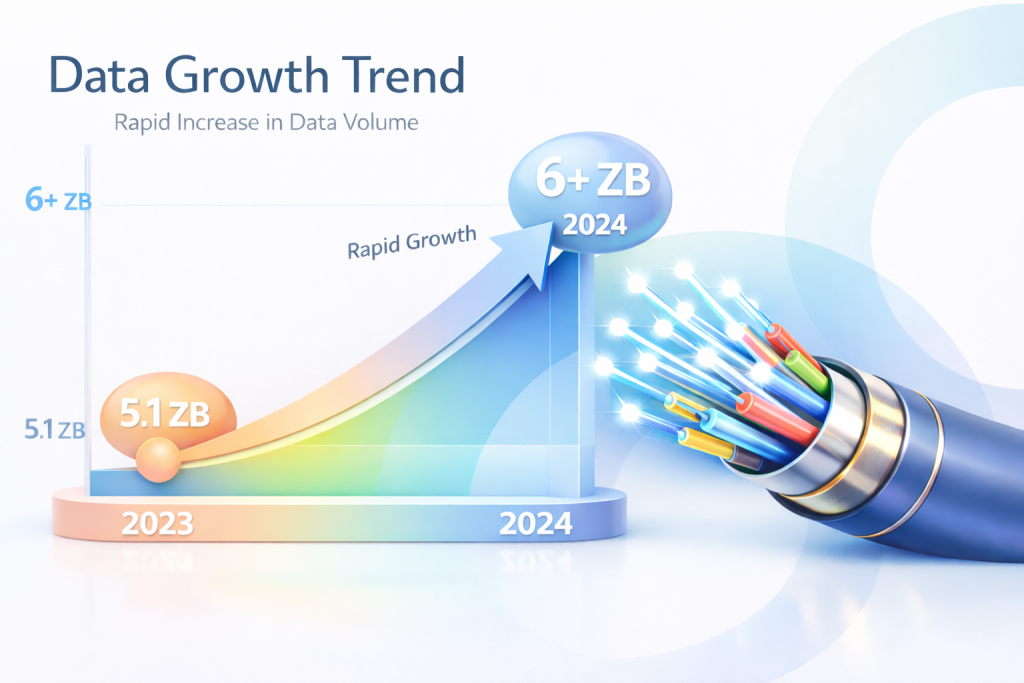
Global data use is growing very fast, and networks must carry more traffic every year. This way, making a strong infrastructure is now essential. Reports from the ITU say fixed broadband traffic could pass 6 zettabytes in 2024, up from 5.1 zettabytes in 2023. This growth is driven by mostly over fiber‑based internet cable that can handle high speeds and heavy workloads.
At the same time, many operators want more control over that capacity. Thus, they are moving from renting bandwidth toward owning their own physical fiber infrastructure. This is why dark fiber is becoming a key choice for long‑term performance, flexibility, and cost efficiency.
How to choose an internet cable?
Choosing an internet cable should be based on distance, speed needs, environment, and future growth. For modern networks, fiber-optic cables are usually the best choice. This is because fiber optics carry most high-speed broadband traffic around the world. Millions of kilometers of new fiber are installed each year to support this demand. Single-mode fiber is usually used for long-distance routes. Meanwhile, multimode fiber is common inside buildings and data centers, where connections are shorter and need high port density. With this in mind, it is important to understand what to consider when choosing a cable.
Key factors for selecting the right cable include:
- Match distance and bandwidth: Ensure the cable supports required speed over the needed length.
- Use single‑mode for backbone: Choose single‑mode fiber for city, regional, and long‑distance routes.
- Use multimode for short links: Apply multimode fiber for short, high‑density data center or office runs.
- Check optics compatibility: Match internet cable type with current and future optical modules.
- Plan latency and diversity: Keep routes short and add backup paths for resilience.
- Follow rules and standards: Use cables that meet safety, fire, and international technical standards.
7 Steps to deploy dark fiber internet cable
Deploying dark fiber internet cable follows clear steps that connect business needs with network design and on-site work. As 5G, cloud services, and AI grow, networks must handle today’s traffic and much more in the future. By following the steps below, teams can move smoothly from planning to building and daily use.
1. Define demand and service objectives
Start by listing who will use the network and what they need, such as data centers, mobile operators, or enterprise sites. Turn these needs into clear targets like capacity per route, maximum delay, and uptime goals, so the design reflects real demands.
2. Design the optical architecture
Create a network layout that supports today’s traffic while allowing growth, choosing between ring, mesh, or point‑to‑point topologies. Decide how much internet cable capacity and how many fiber pairs are needed, so new services and higher speeds can be added later without rebuilding routes.
3. Select fiber and passive components
Based on the design, choose single‑mode or multimode fiber and the right cable type, such as duct, aerial, or direct‑buried. Check that all components can support current speeds and likely future upgrades, so the physical layer remains useful for many years.
4. Secure permits and rights‑of‑way
Work early with city authorities, utilities, and landowners to obtain permits and land access documents. Good preparation at this step reduces the risk of delays, fines, or route changes during construction.
5. Execute civil works with strict QA
During construction, apply best practices for trenching, duct laying, and cable pulling to avoid damage. Use tests such as OTDR to confirm that signal loss and splice quality match the design, so the network works as expected once it goes live.
6. Integrate monitoring and operations
After the network is active, connect the internet cable routes to a central monitoring system that can see alarms, breaks, and performance in real time. This visibility helps operators maintain strong service levels and deliver the high uptime that customers expect.
7. Plan for scalability and upgrades
Reserve spare ducts and fiber pairs so new capacity can be added as traffic grows. This forward‑looking approach makes it easier to connect new data centers, support more 5G sites, and introduce faster optical technology without major new civil works.
Conclusion
The rapid rise in global data use makes dark fiber internet cable a smart long‑term choice for organizations that need control, speed, and room to grow. By clearly understanding both current and future needs, and then choosing the right fiber type and cable design, companies build a strong base that can support more users, more services, and higher speeds without constant rebuilds or costly changes to the physical network.
For organizations that want support across this entire journey in Southeast Asia, ARNet offers an AI‑grade, all‑fiber internet cable network of more than 10,000 km across Thailand, Malaysia, Singapore, and Indonesia. ARNet owns and operates its infrastructure end‑to‑end, combining planning, deployment, and monitoring to deliver fast, stable, and scalable connectivity that fits data center, metro, and long‑haul needs. For more information, you can visit our website or reach out to our team.
About the Author
Nabila Choirunnisa, Digital Marketing Executive at ARNet