Every second, billions of bits of information move around the world through tiny fiber optic cables that we can’t see. But most businesses don’t think about what powers their internet until something breaks. If you run a data center, manage cloud systems, or work with large amounts of data, you’ve probably faced slow speeds or limits. Many times, your internet provider just can’t give the speed and stability you need. That’s where dark fiber helps.
It’s not a new tool, but it’s becoming the main way big companies move their most important data. This way, it gives them their own line, more control, and the freedom to grow without sharing with others. To understand this better, learning about dark fiber is important.
What is the dark fiber?
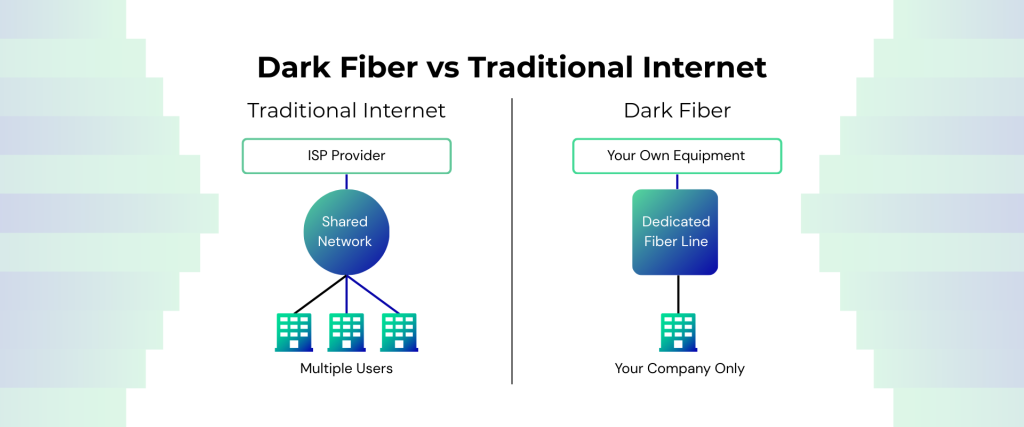
Dark fiber is unused optical fiber cable that’s already laid in the ground or installed in infrastructure. It remains unlit because no transmission equipment has been connected to activate it. Because of this, it has no active electronics or signals running through it. As a result, organizations can lease or own these fiber strands and run their own equipment, bandwidth, and network design on top of them.
What makes this different is the control it gives you. You install your own equipment at both ends, set your own rules, and decide exactly how to use the capacity. In other words, there’s no middleman throttling your speeds or charging you for extra bandwidth next month. Moreover, you’re not competing with other users for resources. If you need more capacity, you simply upgrade your equipment, not your service plan. For companies dealing with sensitive data or needing guaranteed performance, this level of independence is invaluable.
Market growth and statistics
The demand for dark fiber is rising fast as companies grow their networks. This rise is mainly because of machine learning, cloud growth, and big data centers. As businesses build systems that handle heavy computer work and real-time data, they need more network capacity. Because of this, private, high-capacity networks are now very important.
A report fromData Center Knowledge shows that bandwidth for data center links grew by almost 330% from 2020 to 2024. The growth of AI systems plays a big role in this because training and running models need very large data links.Grand View Research also says the global dark fiber market may reach about 13.45 billion dollars by 2030 as large tech companies and enterprises move from renting bandwidth to owning their own networks to save money and improve performance.
Future Market Insights gives similar numbers, estimating the market at 7.0 billion dollars in 2025 and expecting a yearly growth rate of 9.4% through 2035. All of this shows a clear trend: companies are not only buying internet service anymore, they are investing in the physical network paths that keep the digital world running.
Why enterprises are making the switch
The move to dark fiber isn’t just about getting faster speeds, but it’s also about having more control. Many companies choose this litr fiber because it gives them several clear benefits:
- Scalability: With dark fiber, you can increase bandwidth by upgrading your own equipment at both ends. You don’t need to wait for a provider to add a new line.
- Security: Because the fiber is used only by your company, it stays separate from the public internet. This lowers the chance of anyone accessing your data or doing DDoS attacks.
- Latency: For banks, trading systems, and AI setups, every millisecond matters. Dark fiber sends data through the most direct path with fewer stops, helping reduce delays.
Powering southeast asia with ARNet
As Southeast Asia’s digital world grows, choosing a dark fiber provider with stable and strong infrastructure is very important. This is whereARNet stands out. ARNet owns and runs an AI-ready, all-fiber network that stretches over 10,000 kilometers across Thailand, Malaysia, Singapore, and Indonesia.
ARNet stands out as the only single-entity provider in the region that controls all key licenses and builds its own land and subsea network. Because ARNet plans, builds, and operates everything in-house, it delivers consistent performance, better route options, and full control over network quality. With fast and predictable deployment, clear milestones, and a committed SLA backed by real-time monitoring, ARNet gives businesses a reliable, high-speed foundation built for today’s heavy data and AI workloads. To learn more about ARNet’s network and infrastructure approach, you can visit the ARNet website.
About the Author
Nabila Choirunnisa, Digital Marketing Executive at ARNet