Modern businesses need data centers to store and handle huge amounts of information. This is why data center connectivity is growing so fast today. In fact, Grand View Research shows that the global data center market was worth USD 383.82 billion in 2025. It is expected to reach USD 902.19 billion by 2033. These numbers will continue to grow quickly. As a result, companies need their data centers to talk to each other quickly and smoothly. They need to connect to other buildings, cloud services, and their customers.
Because of this growing need, good data center connectivity and planning has become important for companies in all industries. Beyond basic setup, the quality of connections between data centers directly affects how fast apps run. It affects how well services work. As the amount of data continues to grow, businesses look for connectivity solutions that offer high speed, low delays, and complete control over their network setup.
For these reasons, dark fiber has become a popular choice. It helps companies that want to build their own private networks between buildings. However, to understand how this works, we first need to explore what data center connectivity means.
What is data center connectivity?
Data center connectivity is how data centers connect to each other and to the internet. These connections help data move between computers and other devices.
Companies use different ways to connect. For example, they use cables, wireless links, or rented network lines. Choosing the right connection helps businesses keep their systems fast and stable.
How are data centers connected?
Data centers connect to each other using fiber optic cables, wireless links, or rented network lines. The choice depends on their needs. Most buildings use fiber optic cables because they are fast and reliable. In many cases, companies rent lit fiber from telecom providers. With this option, the provider handles the equipment and manages the bandwidth.
Another option is dark fiber. This means companies use unused fiber lines and control them fully. They can install their own equipment and upgrade the network anytime without waiting for approval. According to Grand View Research, the dark fiber market was worth USD 6.25 billion in 2024, showing strong demand for this solution. Still, choosing the right connection depends on several factors that affect data center connectivity performance.
What are the 4 types of data centers?
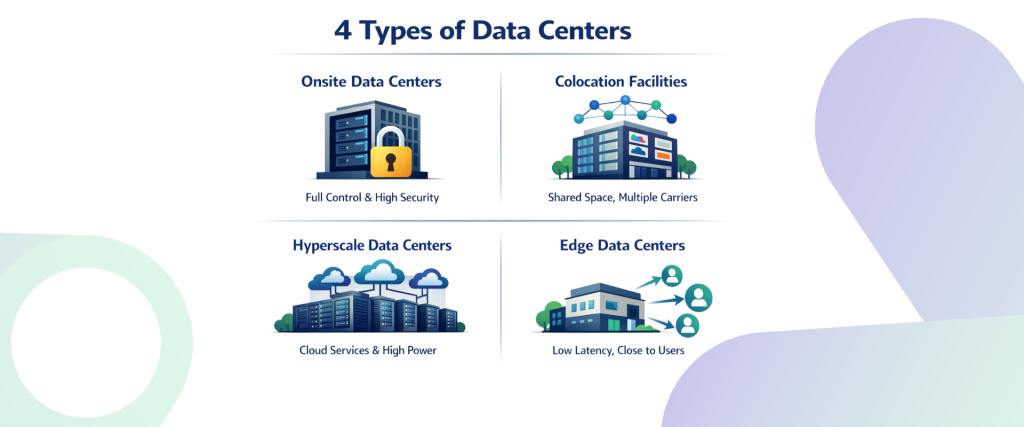
There are four main types of data centers: onsite data centers, colocation facilities, hyperscale data centers, and edge data centers. Each type supports different business needs. They also offer different options for data center connectivity.
Onsite data centers
These data centers are built inside a company’s own location. This means the company has full control over the systems and network. Onsite data centers are suitable for businesses with high security needs. They also work well for companies that use special or custom equipment.
Colocation facilities
Unlike onsite centers, colocation facilities are shared by many companies. The provider supplies power, cooling, and network access. These facilities offer strong connectivity options. They allow companies to connect easily to multiple carriers and internet exchanges.
Hyperscale data centers
Big tech companies use these very large data centers. They support cloud services that need a lot of power. These data centers must connect many locations together. Strong connections help them share data smoothly.
Edge data centers
These are smaller data centers placed close to users. They help reduce delay by handling data nearby. Because of this, they need good connections to main data centers and cloud systems. Without strong connections, they cannot work well.
Knowing these types of data centers helps companies choose the best setup for their needs.
Conclusion
Strong data center connections are important for daily work. Today, companies need fast speed, low delay, and safe networks. Because of this, many companies choose dark fiber.
In this case, ARNet provides dark fiber for companies that want their own private network. With this service, ARNet gives unused fiber lines that connect buildings and data centers. So, companies can run their systems more smoothly.
Also, many companies choose ARNet because the fiber can grow as their needs grow. At the same time, it gives safe and stable connections. In the end, this setup helps companies control their network and work without problems.
About the Author
Nabila Choirunnisa, Digital Marketing Executive at ARNet