The internet around the world runs through physical cables placed under the ocean. These submarine cables carry more than 95% of global data between countries. According to Grand View Research, the submarine cable market reached USD 31.70 billion in 2024. This market keeps growing because more people need fast and stable internet. A submarine cable map shows where these cables connect countries and continents.
Dark fiber works together with submarine cables to support strong network systems. Dark fiber means unused fiber optic cables that companies can rent or own for their own networks. Many businesses use a submarine cable map to see where cables land and plan their connections. Because of this, understanding how submarine cables and dark fiber work together helps companies choose the right internet setup.
How deep are submarine cables buried?
Submarine cables are buried at different depths based on where they are located. A submarine cable map typically shows the routes of these cables across the ocean floor. In shallow waters near the coast, crews bury cables 1 meter deep into the ocean floor. This protects them from ship anchors and fishing nets. According to KIS-ORCA, special underwater plows dig narrow trenches to bury the cables.
However, deep ocean areas do not need cable burial. Instead, cables in deep water just sit on the ocean floor. This is because fewer ships and fishing boats go to those deep areas. Looking at any submarine cable map, you can see that cables crossing deep ocean trenches sit at depths over 8,000 feet below sea level. Meanwhile, companies use water jets and underwater robots to bury cables in areas up to 2,000 meters deep.
What happens when undersea internet cables are cut?
Damaged submarine cables quickly stop internet services. Countries lose their internet connection until workers fix the cables. A submarine cable map helps network operators see which cables are affected and plan alternate routes during outages. For example, Internet Society reported that in March 2024, four cables were damaged off the coast of West Africa. This affected many countries at the same time.
Fixing broken cables needs special ships and trained workers. First, workers pull the broken cable from the ocean floor onto the repair ship. Then, they connect new cable pieces to fix the break. Most simple repairs take 5 to 15 days. However, harder repairs in dangerous areas can take many months. For instance, Recorded Future found that cable breaks in the Red Sea in February 2024 took almost five months to fix. This was because of permit delays and safety concerns in that region.
Why do we need undersea cables with satellites available?
There are many reasons why submarine cables are still very important today:
- Capacity: Submarine cables can carry a lot of data, up to 200 terabits per second. Satellites can only carry a small amount of data.
- Cost: Based on BISI, building submarine cables costs around USD 100–500 million. Satellite systems are much more expensive and can cost USD 5–10 billion.
- Reliability: Submarine cables can work for about 25 years. Satellites usually work for only 5–10 years.
- Speed: Fiber optic cables send data much faster than most satellites.
Satellites are still useful in places where cables cannot reach. Remote islands and far areas often use satellites because it is hard to install cables there. But according to TeleGeography, satellites carry less than 0.37% of the world’s data. Most busy coastal areas use submarine cables instead.
MarketsandMarkets also says the submarine cable market reached USD 19.95 billion in 2025. It is expected to grow to USD 33.75 billion by 2030. Big companies like Google and Meta continue to build new submarine cables. Today, there are 559 active submarine cable systems around the world.
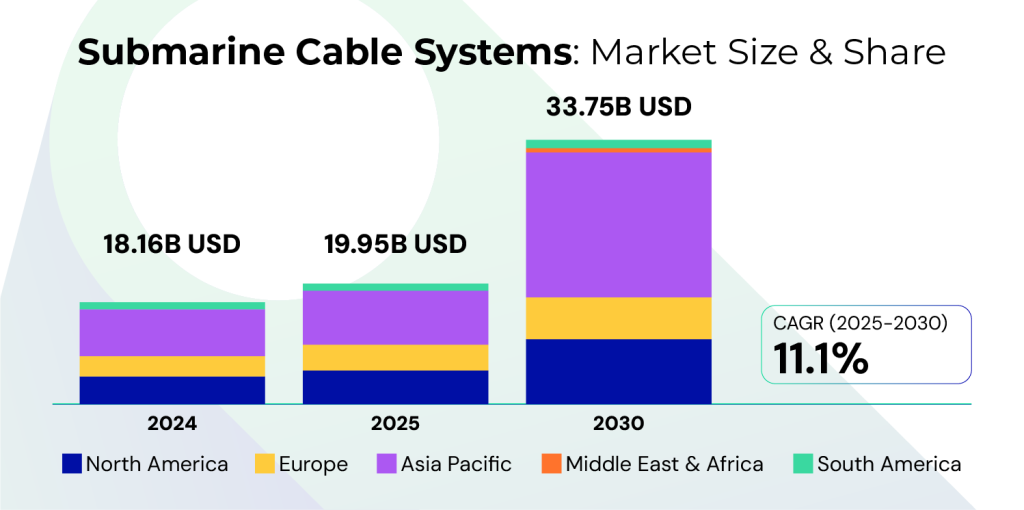
Source: Markets and Markets, 2025
Building reliable network infrastructure
Submarine cables are the main foundation of global internet connectivity. Businesses need reliable fiber infrastructure to send and receive their data. Dark fiber solutions give dedicated bandwidth without sharing with other users. This means companies can grow their network speed as they need more data capacity. Companies can check the submarine cable map to see how their location connects to global networks.
ARNet provides dark fiber solutions that connect businesses to important network infrastructure. Our dark fiber services let companies control their own network capacity and speed. ARNet’s infrastructure links to major submarine cable landing stations and data centers across the region. We help businesses understand the submarine cable map and connect to the right landing points for their needs. If your business needs connections between countries in Southeast Asia using sea cables, ARNet can help. We help businesses understand the submarine cable map and connect to the right landing points for their needs.
Choose ARNet because we offer dedicated fiber solutions with guaranteed bandwidth and low delay times. Our network infrastructure helps businesses that need secure and reliable internet for their work. ARNet’s dark fiber services remove the speed limits that shared networks create. This gives your company the performance needed for applications that use lots of data.
About the Author
Nabila Choirunnisa, Digital Marketing Executive at ARNet