

Cables under the ocean support most of the internet we use every day. Satellites and wireless networks may seem important, but undersea cables carry most of the world’s internet traffic and connect countries. These cables sit on the ocean floor and allow things like video calls, online payments, cloud services, and social media to work.
As people and businesses connect more online, these cables matter even more. Big tech companies are spending a lot of money to build new undersea cables. At the same time, people are more worried about keeping them safe and working well. Because they can send large amounts of data very fast, these cables are essential to the global digital world.
What are undersea cables?
Undersea cables are also called underwater cables. They are fiber optic cables placed on the seabed. These cables connect countries and areas across the sea. They send data using light. This allows information to move very fast and in very large amounts.
New cables can carry huge amounts of data every second. They can send data across very long distances. According to BBC Future, each cable is about 2 centimeters thick. This is similar to a garden hose. Each cable runs for thousands of miles under the sea.
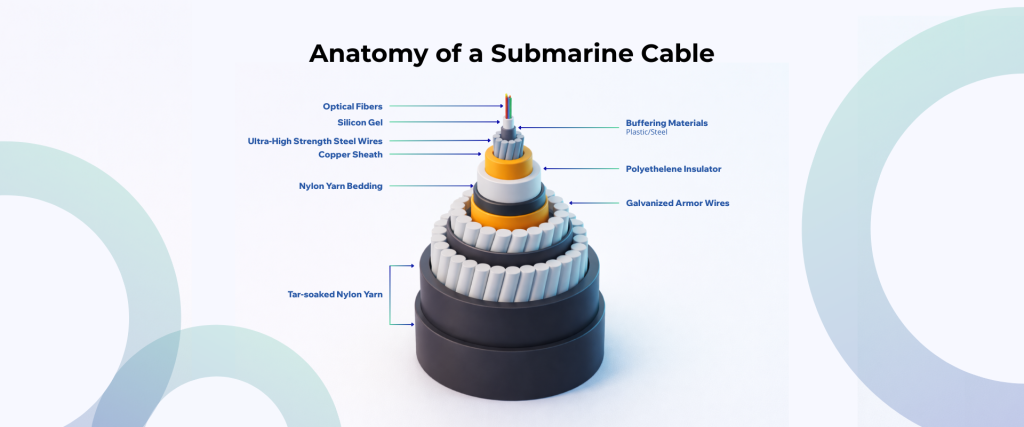
This cable system is very large. Recorded Future reports that, as of April 2025, about 597 underwater cables are working or being built around the world. These cables connect continents, companies, and homes. At the same time, the International Telecommunication Union said that companies installed almost 200,000 kilometers of new cables in 2024 alone. Altogether, these cables are about 1.4 million kilometers long. This is enough to go around the Earth more than 35 times, based on data from Subsea Cables.
The expanding scale of infrastructure
This enormous network drives an industry experiencing rapid growth due to rising global data demand. According to Precedence Research, the global submarine cable system market was valued at USD 22.96 billion in 2025 and may reach USD 54.81 billion by 2034, expanding at a compound annual growth rate of 10.15%. These cables carry about 99% of all intercontinental internet traffic, as reported by the Atlantic Council, while satellites handle less than 5% and operate at much lower speeds.
However, this expansion comes with physical challenges. The International Cable Protection Committee (ICPC) reports an average of 199 undersea cable faults each year worldwide. Fishing and anchoring cause around 86% of these disruptions. Despite a 50% increase in cable route distance since 2013, the industry has kept fault rates stable through better protective measures, according to Submarine Networks.
Why undersea cables matter for global connectivity
Undersea cables are long cables under the ocean that carry the internet around the world. They are very important for daily life and for the world economy. These cables help people, businesses, and countries stay connected.
- Global economy: Based on a report from Subsea Cables, undersea cables facilitate more than $10 trillion in financial transfers every day, enabling online commerce, banking, and trade.
- Daily services: They power video calls, cloud storage, data centers, and online healthcare systems.
- Future networks: According to Research and Markets, undersea cables are vital for 5G networks and are increasingly used in clean energy projects that transmit both power and data.
- Internet access: In Indonesia, the Palapa Ring network connects seven island groups, improving connectivity in rural regions.
Building resilient digital infrastructure
The world uses undersea cables more than before. Because of this, strong networks are needed. But many networks do not have backup lines or fast repair teams. When a cable breaks, places without backups can lose internet for a long time. Also, political problems and slow repairs can make this worse. This can harm communication and business.
For this reason, undersea cable networks must be ready. At the same time, more people use digital services every year. So, staying online during problems is very important. To reduce risk, companies should use backup systems. For example, more than one route helps keep the network working.
In Southeast Asia, a good internet is important for business. Without it, companies can fall behind. ARNet is a top dark fiber provider. It runs an all-fiber network built for AI. The network covers over 10,000 kilometers. It reaches Thailand, Malaysia, Singapore, and Indonesia. By using sea and land cables, ARNet connects 60 data centers. Because of this, it offers clear SLAs and fast setup with one license.
About the Author
Nabila Choirunnisa, Digital Marketing Executive at ARNet