

Every device connected to a network needs an IP address to communicate. Think of it as a digital mailing address that helps information reach the right place. Meanwhile, dark fiber networks are unused fiber optic cables that companies lease to build their own private networks. As a result, understanding IP address classes helps organize data flow and keeps all devices connected properly.
Furthermore, recent data from IP2Location’s 2024 report shows big changes in IP address distribution across 249 countries during 2023. Notably, Australia moved up to 10th place, while Singapore climbed to 24th, and Seychelles jumped 25 spots to reach 99th place. Thus, these changes show that more companies around the world are building network infrastructure and, consequently, need proper IP address classes to manage their growing dark fiber systems.
What are the 5 classes of IP addresses?
The 5 classes of IP addresses are Class A, Class B, Class C, Class D, and Class E. Specifically, these IP address classes split the available IPv4 address space into different groups based on their size and what they’re used for. Initially, network engineers created this system to help companies organize addresses based on what they need.
Furthermore, IP address classes serve different networking needs and have their own address range. Primarily, Class A, B, and C handle regular network operations. Meanwhile, Class D takes care of special multicasting functions. In contrast, Class E stays reserved for experimental work. Finally, the first few bits of an IP address tell you which class it belongs to.
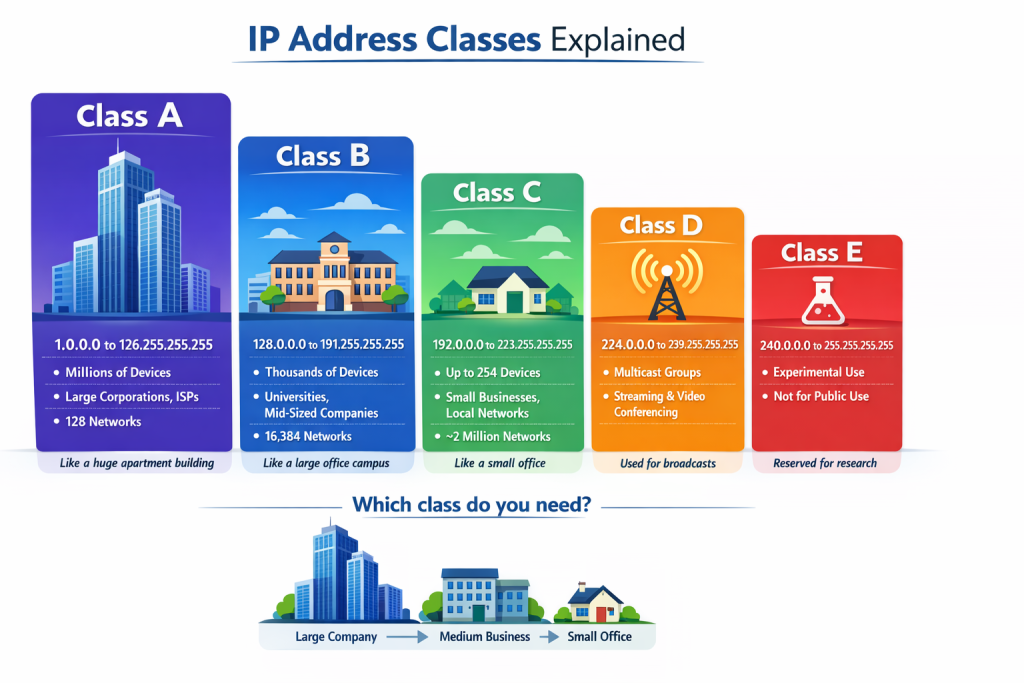
Class A networks
Class A addresses start with numbers from 1 to 126 in the first section. These networks work for very large companies because they can handle millions of connected devices. The first 8 bits identify the network, and the remaining 24 bits identify individual devices in that network.
A typical Class A address looks like 10.x.x.x, where “x” can be any number from 0 to 255. Big internet service providers and large corporations use these addresses for their operations. Only 128 Class A networks exist worldwide, which makes them rare and valuable for managing large dark fiber infrastructure.
Class B networks
Class B addresses go from 128.0.0.0 to 191.255.255.255. These networks fit well for medium-sized companies like universities, regional offices, or mid-sized businesses. The first 16 bits identify the network, and the last 16 bits identify individual devices.
Companies with thousands of devices find Class B networks practical. They balance the number of available networks with how many devices each network can support. About 16,384 Class B networks are available around the world, giving growing businesses plenty of options.
Class C networks
In IP address classes, Class C addresses range from 192.0.0.0 to 223.255.255.255. These addresses are commonly used by small businesses and local networks. In this IP address class, the first 24 bits are used for the network, while the remaining 8 bits are used for device addresses.
Each Class C network can support up to 254 devices. This makes it a good choice for small offices or branch locations. There are about 2 million Class C networks available, giving small companies many options without needing complex or expensive network setups.
Class D networks
Class D addresses range from 224.0.0.0 to 239.255.255.255. These addresses handle multicast traffic, which means one sender can send data to multiple receivers at the same time. Video conferencing platforms and streaming services use this class often for smooth content delivery.
Regular networks don’t assign Class D addresses to individual devices. Applications and services use them for group communication instead. This makes them useful for sending content across dark fiber networks to many endpoints at once, which saves bandwidth and improves efficiency.
Class E networks
Class E addresses go from 240.0.0.0 to 255.255.255.255. Researchers and developers keep these addresses for experimental work and future applications. Regular networks can’t use these addresses for normal operations.
The Internet Engineering Task Force holds these addresses for testing new protocols and networking technologies. While they exist in the IP address classes framework, they can’t be used on the public internet. This gives future innovations dedicated resources for testing and development.
Conclusion
Understanding IP address classes helps you build networks that fit your company’s needs. Class A, B, and C handle regular network operations for different company sizes. Class D manages multicast traffic and Class E stays reserved for experimental use. When you understand these classifications, you can design reliable dark fiber networks that grow with your business and support increasing connectivity needs across your infrastructure.
Picking the right IP address classes makes sure your network performs well and can grow when you need it to. However, implementing these configurations properly requires reliable dark fiber infrastructure as the foundation for your network. ARNet provides professional dark fiber solutions that support proper IP address implementation and network design. Their infrastructure gives your business the bandwidth and flexibility needed for modern network demands. With strong expertise in dark fiber, ARNet’s experienced team helps companies make smart infrastructure decisions.
Choosing ARNet means working with a provider who delivers reliable, high-capacity fiber connections built for growth. Our network infrastructure supports IP address classes and setup your company needs, from small branch offices to company-wide deployments. ARNet’s technical knowledge helps businesses build networks that work great today and scale easily for tomorrow’s needs.
About the Author
Nabila Choirunnisa, Digital Marketing Executive at ARNet