

Artificial intelligence changes how businesses work. To make this possible, companies build AI data centers to run artificial intelligence programs. These buildings use powerful computers to handle heavy work. They store large amounts of data and drastically increase power consumption due to high-density computing needs.
People build AI data centers to handle heavy computing, store large amounts of data, and use the high power AI systems needed. So what actually sets them apart? This article explains what makes these facilities unique and describes the four main types of data centers available.
What is the AI data center?
An AI data center is a special building that holds powerful computers for artificial intelligence. These computers are used to train models and run AI applications. Compared to normal software, these workloads need much more computing power. Because of this, the facility uses strong chips like GPUs and TPUs that can do many tasks at the same time. It uses very fast networks and large storage so data can move quickly between servers. As a result, AI systems can work faster and deliver better results.
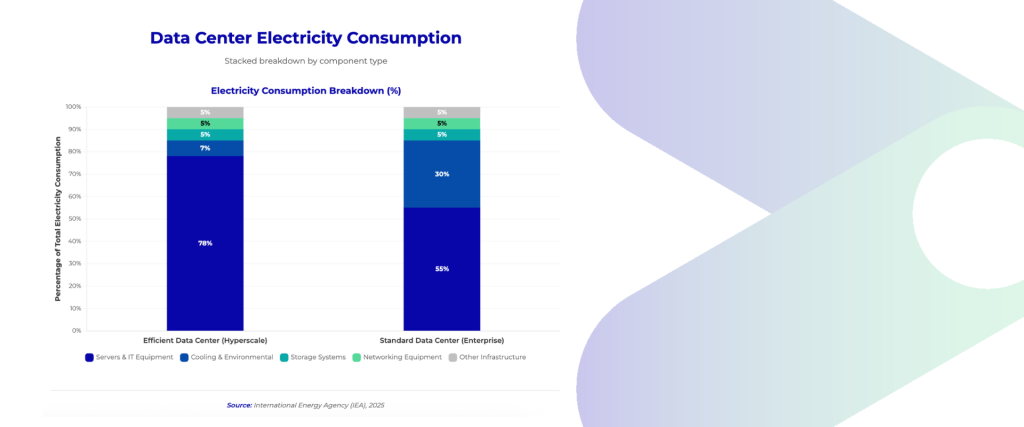
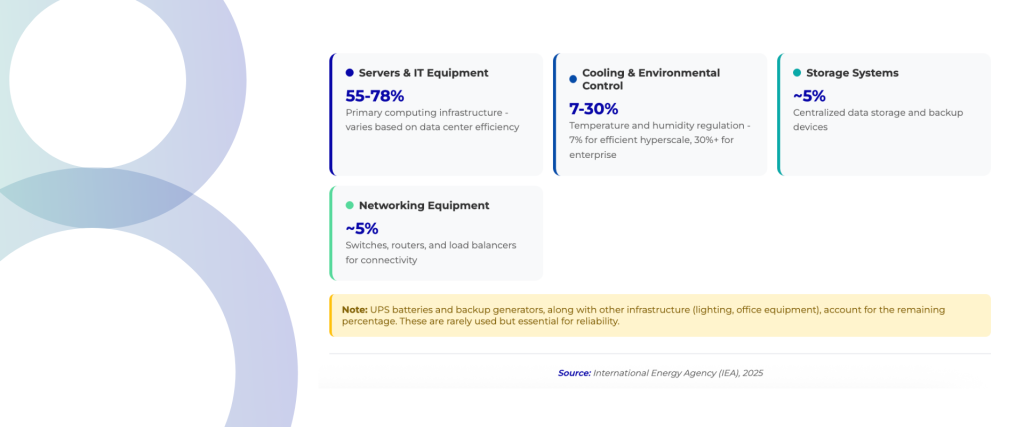
However, high performance brings challenges. An AI data center uses a lot of electricity and produces a lot of heat. The International Energy Agency (IEA) reported that data centers used about 415 TWh of electricity in 2024. This is 1.5% of all electricity in the world, and it has been growing about 12% every year. The report says that electricity use will double to about 945 TWh by 2030, taking up almost 3% of the world’s electricity, mainly because AI servers are growing fast. For this reason, strong power systems and advanced cooling keep operations safe and stable.
What are the 4 types of data centers?
Data centers come in four main types: onsite data centers, colocation facilities, hyperscale data centers, and edge data centers. These types support different needs and workloads, including those used in an AI data center. While they serve the same basic purpose, they differ in scale, location, and operation. The following sections explain each type in more detail.
- Onsite data centers: Onsite data centers are owned and run by the company on its own property. The company controls all equipment and security. They keep private information safe but cost a lot and need trained staff.
- Colocation facilities: Colocation facilities are shared buildings where companies rent space for their servers. The building provides power, cooling, and internet. It costs less than building your own AI data center, but companies still control their own equipment.
- Hyperscale data centers: Hyperscale data centers are very big and hold thousands of servers. Big tech companies usually run them. They can grow quickly and use advanced cooling to stop equipment from overheating.
- Edge data centers: Edge data centers are small and placed close to users. They process data nearby so it moves faster. They help run IoT devices, self-driving cars, and video streaming.
Infrastructure that powers AI growth
AI data center do more than house powerful computers. They handle heavy workloads, store large amounts of data, and manage high electricity use safely and efficiently. What makes them unique is their use of advanced chips, fast networks, and strong cooling and power systems. As AI grows, businesses rely on these centers for speed, reliability, and flexibility in handling complex computing tasks.
To support this growth, fast and stable networks are critical. Large amounts of data must move quickly between systems without delay. Dark fiber provides high speed, low latency, and reliable connections. This allows advanced computing workloads to run smoothly and scale when demand increases.
In Southeast Asia, choosing the right network partner is key to success. ARNet builds dark fiber networks for hyperscalers and major players across Indonesia, Malaysia, Singapore, and Thailand. Our long-haul, metro, and last-mile fiber solutions give businesses full control over network speed and reliability. With our networks, companies can easily expand capacity as AI workloads grow, ensuring smooth performance at every stage. We give businesses the tools to build their AI data center. We help them grow across the region.
About the Author
Nabila Choirunnisa, Digital Marketing Executive at ARNet